
IAAPA

International Association Against Psychiatric Assault
Spechtweg 1, 4125 Riehen, Switzerland
The association is a Human Rights organization that opposes psychiatric coercion and aims to abolish psychiatric coercive measures altogether and to promote the fundamental rights of self-determination, liberty, and human dignity.

UN: "Insanity defence" must be-
abolished !
 

The UN High Commissioner for Human Rights acceptetd our demand put forth in our statutes article 2.(B) h. to abolich the UN resolution 46/119 of December 17, 1991 on the treatment of "mental patients": In a report to the General assembly of UN of "on enhancing awareness and understanding of the Convention on the Rights of Persons with Disabilities" the High Commissioner definitly states, that
  • the Insanity defense "must be abolished" (see Article 47 below)
  • and that the "Convention radically departs " from the UN resolution ...on treatment of "mental patients" (see Article 48 below)
  • that all mental health laws using the pretex "as the likelihood of them posing a danger to themselves or others" "must be abolished" (see Article 49 below)

"47. In the area of criminal law, recognition of the legal capacity of persons with disabilities requires abolishing a defence based on the negation of criminal responsibility because of the existence of a mental or intellectual disability.41 Instead disability-neutral doctrines on the subjective element of the crime should be applied, which take into consideration the situation of the individual defendant. Procedural accommodations both during the pretrial and trial phase of the proceedings might be required in accordance with article 13 of the Convention, and implementing norms must be adopted.5. Right to liberty and security of the person

48. A particular challenge in the context of promoting and protecting the right to liberty and security of persons with disabilities is the legislation and practice related to health care and more specifically to institutionalization without the free and informed consent of the person concerned (also often referred to as involuntary or compulsory institutionalization). Prior to the entrance into force of the Convention, the existence of a mental disability represented a lawful ground for deprivation of liberty and detention under international human rights law.42 The Convention radically departs from this approach by forbidding deprivation of liberty based on the existence of any disability, including mental or intellectual, as discriminatory. Article 14, paragraph 1 (b), of the Convention unambiguously states that “the existence of a disability shall in no case justify a deprivation of liberty”. Proposals made during the drafting of the Convention to limit the prohibition of detention to cases “solely” determined by disability were rejected.43 As a result, unlawful detention encompasses situations where the deprivation of liberty is grounded in the combination between a mental or intellectual disability and other elements such as dangerousness, or care and treatment. Since such measures are partly justified by the person’s disability, they are to be considered discriminatory and in violation of the prohibition of deprivation of liberty on the grounds of disability, and the right to liberty on an equal basis with others prescribed by article 14.

49. Legislation authorizing the institutionalization of persons with disabilities on the grounds of their disability without their free and informed consent must be abolished. This must include the repeal of provisions authorizing institutionalization of persons with disabilities for their care and treatment without their free and informed consent, as well as provisions authorizing the preventive detention of persons with disabilities on grounds such as the likelihood of them posing a danger to themselves or others, in all cases in which such grounds of care, treatment and public security are linked in legislation to an apparent or diagnosed mental illness....

41 Often referred to as “insanity defence”.
42 See for reference the Principles for the Protection of Persons with Mental Illness and the Improvement of Mental Health Care, A/RES/46/119, available at: http://www.un.org/documents/ga/res/46/a46r119.htm.
43 In the course of the third session of the Ad Hoc Committee on a Comprehensive and Integral International Convention on the Protection and Promotion of the Rights and Dignity of Persons with Disabilities, proposals were made to add the word “solely” to then draft article 10, paragraph 1 (b), so it would read “any deprivation of liberty shall be in conformity with the law and in no case shall be based solely on disability.

The report in English | French | Russian | Spanish | Chinese | Arabic


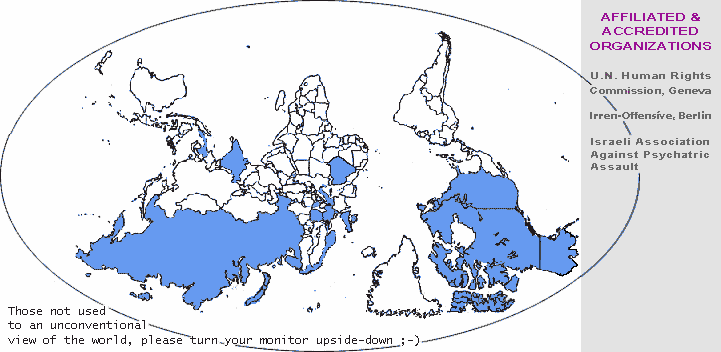
Polish IAAPA Section Please click here to see an explanation for this unconventional view of the world!

Blue marks the countries where we currently have members:
Algeria, Belgium, Canada, Germany, Great Britain, Hungary, India, Ireland, Israel, Italy, Norway, Poland, Russia, Switzerland, Thailand, USA

IAAPA is not only "radical" in its aims, it also has a true democratic "revolutionary" form: the General Assemblies take place legally via the internet and thereby completely save travel expenses for our members. In this way members from poor countries and poor members from rich ones can participate in the decision making process without the need to depend on doctors' associations, pharmaceutical sponsors or the state for reimbursing their travel costs. After all, internet cafés are nearly everywhere nowadays.


Organizational Agenda

IAAPA Secretariat: Vorbergstr. 9a, 10823 Berlin, Germany
Members of the executive committee:
- Webmaster: Hagai Aviel,
79/2 Ibn Gvirol, 64046 Tel Aviv, Israel - iaapa@hotmail.com
- Secretary: René Talbot -
- IAAPA U.N. Representative: Peter Zihlmann,
Spechtweg 1, 4125 Riehen, Switzerland
- Russian sub-division (Resolution point #4 of GA on March 30, 2004):
- Office in Barnaul (Siberia): Representative is Igor Girich - hvp@alt.ru
- Polish sub-division: Representative is Andrzej Skulski - iaapa-polska@freenet.de
Bank account for Swiss Francs and US$:
IAAPA, Credit Suisse: Albangraben 1-3, Basel, Account No. 0060-997776-51
IBAN: CH57 0406 0099 7776 5100 0
BIC: CRESCHZZ80A
(Swiss members using online banking on yellownet.ch please use #30-3200-1-4060-997776-51)

Bank account for Euro:
IAAPA, Deutsche Bank Berlin, Account-No: 077771400, BLZ: 10070000
IBAN: DE24 1007 0000 0077 7714 00

BIC: DEUTDEBBXXX
Date and time of next General Assembly (G.A.): Tuesday, 6th of March 2012 at 16.00 GMT (your local time?)

Our magazines
ZWANG No. 1
English
ZWANG No. 2
English / Deutsch
ZWANG No. 3
English / Deutsch
ZWANG No. 4
English / Deutsch
For an English print version of ZWANG No. 1, please mail your postal address to our Secretary:


iaapa contest
 

Deception failed

Statement the German Association: Bundesarbeitsgemeinschaft Psychiatrie-Erfahrener on the ratification of the Convention on the Rights of Persons with Disabilities in Germany.
O

Informationen zur Ausstellung "Tödliche Medizin" im Jüdischen Museum in Berlin und dem Hygiene Museum in Dresden

Article in Haaretz / Information on the exhibition "Deadly Medicine" in the Jewish Museum/Berlin and the Hygiene Museum/Dresden


newspaper article: silence about the victims after 1945

Resolutions

Our letter to the High Commissioner for Human Rights, Mrs. Navanethem Pillay:

International Association Against Psychiatric Assault

because Human Rights are indivisible

IAAPA - 79/2 Ibn Gvirol - 64046 Tel Aviv - Israel


High Commissioner for Human Rights
Mrs. Navanethem Pillay
Palais des Nations
CH-1211 Geneva 10
Switzerland

November 2, 2008

Implementing the CRPD in Germany

International
Association
Against
Psychiatric
Assault
IAAPA

Spechtweg 1
4125 Riehen
Switzerland


www.iaapa.ch

Speaker of the Executive Committee:
Hagai Aviel
79/2 Ibn Gvirol
64046 Tel Aviv
Israel
iaapa@hotmail.com

Dear Mrs. Pillay,


May I briefly introduce to you our organization:     
We are a Human Rights organization in the field of psychiatric coercion whose aims are to abolish psychiatric coercive measures altogether and to promote the fundamental rights of self-determination, liberty, and human dignity. We have members in 15 countries world-wide (see also: www.iaapa.ch). 3 of them have ratified the CRPD but without any effect on the practice and the law in their respective countries. From other countries who have ratified the CRPD, from none of them have we received a positive response with regard to psychiatric violence and coercion as contradicted by the CRPD. The German organization Bundesarbeitsgemeinschaft Psychiatrie-Erfahrene e.V. (BPE) has now informed us in a press release on the planned fraud with the CRPD by their government and parliament.

 

We were therefore delighted that in your Information Note No. 4 for the Dignity and Justice for Detainees Week, you took such a clear stance against this planned fraud. We understand that for implementing the CRPD, one has to focus on political steps. Therefore the path the German organization BPE chose to confront the law-making bodies with the consequences of the CRPD before the ratification and demand the necessary changing of the law for the date of the ratification in Germany seems to us the only promising one. Such a strong power as a law-making body of a sovereign country can never be tricked with a contract which has unwanted consequences which they hadn’t intended. Only if they know what they sign/ratify, can you ever expect them to fulfil their promises.


That’s why, in our view, it is so important that the request for supporting a change of the German government’s proceedings is heard and we want to encourage the High Commissioner for Human Rights to defend the CRPD in this crucial situation. Should the Germans get away with such a blatant fraud with the CRPD, who else in the world will then implement the CRPD in the field of psychiatric detainees? The CRPD is in real danger of becoming a symbolic policy of the governing forces without any substantial meaning, especially in such an important area of deprivation of liberty and bodily harm, the core values for human dignity.


Yours sincerely,


Hagai Aviel

(Speaker of the executive committee)


On 13-Dec-2006 the "Convention on the Protection and Promotion of the Rights and Dignity of Persons with Disabilities"1 passed the UN General Assembly. On 30-March-2007 governments signed the Convention in New York. This signature marks the beginning of a political debate about this convention and its political implications for those countries who signed the convention, namely: Algeria, Andorra, Antigua and Barbuda, Argentina, Armenia, Australia, Austria, Bahrain, Bangladesh, Barbados, Belgium, Bolivia, Brazil, Bulgaria, Burkina Faso, Burundi, Cambodia, Canada, Cape Verde, Central African Republic, Chile, China, Colombia, Comoros, Congo, Costa Rica, Cote d'Ivoire, Croatia, Cuba, Cyprus, Czech Republic, Denmark, Dominica, Dominican Republic, Ecuador, Egypt, El Salvador, Estonia, Ethiopia, European Community, Finland, France, Gabon, Germany, Ghana, Greece, Guatemala, Guinea, Guyana, Honduras, Hungary, Iceland, India, Indonesia, Ireland, Israel, Italy, Jamaica, Japan, Jordan, Kenya, Lebanon, Liberia, Lithuania, Luxembourg, Macedonia , Madagascar, Malawi, Maldives, Mali, Malta, Mauritius, Mexico, Moldova, Montenegro, Morocco, Mozambique, Namibia, Netherlands, New Zealand, Nicaragua, Niger, Nigeria, Norway, Panama, Papua New Guinea, Paraguay, Peru, Philippines, Poland, Portugal, Qatar, Republic of Korea, Romania, San Marino, Senegal, Seychelles, Sierra Leone, Slovakia, Slovenia, South Africa, Spain, Sri Lanka, Sudan, Suriname, Swaziland, Sweden, Syrian Arab Republic, Thailand, Trinidad and Tobago, Tunisia, Turkey, Uganda, United Kingdom of Great Britain and Northern Ireland, United Republic of Tanzania, Uruguay, Vanuatu, Viet Nam, Yemen. (see here)

The result of this political process will be that in each of these countries either the convention will be ratified by its legislating bodies (in democratic countries: the parliaments) or not be ratified, which would contradict the prior support of its creation by its government.

Because this convention concerns the human rights of the disabled, it is crucial to terminate the systematic and wide-spread violation of human rights sanctioned by law legalizing psychiatric coercive measures, compulsory hospitalization and forced treatment as well as the arbitrary prolongation of imprisonment in the forensic unit as punishment. If the convention is to be ratified and thus become law in these countries without the psychiatric special laws being invalidated, it would become the opposite of what it intended: it would become another instrument against the civil and human rights of all individuals who were psychiatrically/medically slandered as allegedly being "mentally ill". These "diagnoses" are defined in the convention with the term "disabled" (Article 1, par. 2): "Persons with disabilities include those who have long-term physical, mental, intellectual or sensory impairments … " [Bold and underlining added by us]

The convention explicitly bears down on the legal discrimination of persons with disabilities (Article 2, par. 3):
"… Discrimination on the basis of disability" means any distinction, exclusion or restriction on the basis of disability which has the purpose or effect of impairing or nullifying the recognition, enjoyment or exercise, on an equal basis with others, of all human rights and fundamental freedoms in the political, economic, social, cultural, civil or any other field. …"

The convention thereby explicitly forbids the possibilities which the national constitutions leave open by annulling constitutional rights with special laws if they have a "disability" as criterion. However that is precisely the case with the Mental Health Laws: the laws legalizing psychiatric confinement of non-criminals as well as the special forensic laws of the Penal Code have as an essential requirement a psychiatric assessment and/or a compulsory examination for this. They must therefore be abolished because they contradict the convention.

Moreover, in Article 12 the convention obligates a ratifying state as follows:
Equal recognition before the law
1. States Parties reaffirm that persons with disabilities have the right to recognition everywhere as persons before the law.
2. States Parties shall recognize that persons with disabilities enjoy legal capacity on an equal basis with others in all aspects of life.


Thus any forced guardianship and the compulsory hospitalization, including coercive treatment which is thereby made possible, must be terminated. No longer can the words "protection" and the alleged "well-being" of the persons concerned serve as a cynical pretext for such measures.

To support this legal interpretation of the convention we recommend commissioning an expertise by lawyers specialized in international Human Rights, taking into account the specific national laws.
We call on organizations for persons with disabilities to urgently take a stance against a ratification of the convention by the national legislators if it does not fulfill that which it pledges: legally binding freedom from discrimination. Legal discrimination is exercised in its most radical, brutal and abhorrent form by the laws legalizing coercive psychiatry. Should organizations for persons with disabilities nevertheless press for a rapid ratification because they anticipate the effects of positive discrimination from the convention, a ratification without the abolishment of coercive psychiatry would come at an intolerable price: the continuation of the barbarity of coercive psychiatry with its torture-like practices and the denial of self-determination by individuals who were slandered in the psychiatric-medical jargon as alleged "mentally ill".

A ratification which maintains the Mental Health Laws would make the convention a cynical caricature: The convention would become an additional instrument of camouflage and cover-up for psychiatric violence. It would become a part of the problem instead of its solution.
----
1. Original text of the convention: http://www.un.org/disabilities/default.asp?id=199

Report: We hijacked the WPA congress! -----RESULTS OF THE CONTEST

DOCUMENTATION
Activities
The Szasz Column
Library
A call for immediate intervention of the CPT in Poland (Polski) (Deutsch)
German doctors abandon psychiatrists
International claims list
Zwang (Magazine)
Tips for our issues
Disabeld by Psychiatry and the Law
Tribunals (such as the Foucault and Russell Tribunals)
Streaming film of the Foucault Tribunal

International day for resistance & remembrance of the victims of psychiatry

Pro stigma campaign
UN Human rights section
Cooperation with other human rights groups
New german law possibilities - since 1999 there is a new Representation Agreement Act which can serve the complete abolition of psychiatric coercion as a first loophole to crack the system. (How to promote such a law in other countries.)
Legal aid support fund (national and international)
Awardgiving
Dissident Art
Representative on the subject of forensic psychiatry?
Hardware sponsor fund (to help poor members who have no other resources to purchase a computer and not rely on an internet café)

Archive of previous articles
in the Szasz Column


#21

Senseless
Did the perpetrator of the Tuscon massacre have a reason?

The Therapeutic State | Thomas Szasz

The Freeman: Posted January 20, 2011

Do people really want to know why, on January 8, 2011, in Tucson, Arizona, a young man named Jared Lee Loughner engaged in mass murder? I submit they do not. Politicians, psychiatrists, pundits, and the press univocally assert that Loughner’s deed is the “senseless” product of mental illness. This belief in a non-existing mental disease causing mass murder is on a par with young children’s belief in Santa Claus. It is false but satisfies the believers. The great French essayist Michel de Montaigne (1533-1592) sagely observed: “Nothing is so firmly believed as what is least known.”

Before his shooting spree Loughner had produced a video he called “My Final Thoughts,” stating: “All humans are in need of sleep. Jared Loughner is a human. Hence, Jared Loughner is in need of sleep.” On the morning of his massacre he posted a message on his MySpace account acknowledging his sense that he was at the end of his rope and his decision to let go: “Goodbye. Dear friends . . . Please don’t be mad at me.”

“War is a continuation of politics by other means,” said Prussian general Carl von Clausewitz (1780-1831). I suggest that, similarly, mass murder in plain sight, such as Loughner committed, is a continuation of suicide by other means. Sometimes it is called “suicide by proxy” or “suicide by cop.”

Loughner, to use his metaphor, has gone to sleep. And so have we if we prefer to believe that his self-destructive and destructive act is the senseless product of his “mental illness” rather than the result of his planned, “sensible” decision. The latter view is unpopular and unacceptable because it acknowledges Loughner’s humanity and free will, precisely the qualities that psychiatrists – aided and abetted by the criminal justice system – are intent on removing from persons they label “mad.” This medicalized view of certain offenses – usually crimes that particularly upset people – has, for reasons I have presented elsewhere, become widely accepted in our society, embraced equally by the right and the left.

Normally, we infer the motive for an action from its consequences. For Loughner, one of the consequences of his action is that his life is over, if not biologically then socially. Loughner was well aware of his failure to transition from childhood to adulthood. After years of fruitless travail, he decided to bring his life to a dramatic end. He committed mass murder and let himself be destroyed by the society that, he felt, obstructed his efforts to succeed.

Loughner’s crime, like any act, was not senseless at all, provided we are willing to put ourselves in his shoes. Of course, it makes no sense if we are unwilling to do that, denying the personhood of the actor, dismissing a priori his possessing free will, attributing his action to mental disease instead of personal decision.

Crime Is Alleged, Craziness Is Asserted

The only thing we know with certainty about the Loughner case is the identity of the shooter. We do not know why he committed this crime. Nevertheless, commentators ritually refer to Loughner as the “alleged” assailant and confidently assert that he is a crazy, deranged, lunatic, mentally ill and schizophrenic. Former Vice President Dick Cheney told NBC News: “We need to be a little careful about assuming that somehow the rest of society or the political class bears the responsibility for what happened here when it was the act of a deranged, crazed individual that committed a crime.”

E. Fuller Torrey, a recognized expert on schizophrenic murderers, agrees. He refers to Loughner as “the alleged shooter” and states that he “is reported to have had symptoms associated with schizophrenia … and almost certainly was seriously mentally ill and untreated…. These tragedies are the inevitable outcome of five decades of failed mental-health policies.”

Torrey’s remedy for the problem of people being at liberty to commit crimes and suffer the consequences is intensifying the traditional legal-psychiatric practice of incarcerating innocent individuals and calling it “hospitalization” and “treatment” and even “suicide and crime prevention”: “The solution to this situation is obvious — make sure individuals with serious mental illnesses are receiving treatment. The mistake was not in emptying the nation’s hospitals but rather in ignoring the treatment needs of the patients being released…. Others are unaware they are sick and should be required by law to receive assisted outpatient treatment, including medication and counseling… If they do not comply with the court-ordered treatment plan, they can and should be involuntarily admitted to a hospital.”

In contrast, Ashley Figueroa, a former girlfriend of Loughner, told ABC News that she remembers Loughner as “a drug user with a grudge against the government…. I think he’s faking everything…. I think that he has been planning this for some time.” A writer for Salon.com adds: “Figueroa is not a doctor, and these claims conflict with the opinion of top doctors in the field of psychiatry. (Dr. E. Fuller Torrey actually told Salon that Loughner looks like a ‘textbook’ case of paranoid schizophrenia.)”

True, Figueroa is not a “doctor.” Do we need to have a medical degree to diagnose a person we have never laid eyes on as schizophrenic? Does the fact that Figueroa knew Loughner, that they had a real-life human relationship, count for nothing?

It did not take long for authorities, in Arizona as well as nationally, to heed Torrey’s advice to cure would-be “schizophrenic murderers” by constricting the liberties of all Americans. On January 15, exactly one week after Loughner’s rampage, one of his victims, J. Eric Fuller, 63, a military veteran, attended a televised forum on “helping the community to heal” and angrily confronted a fellow participant with the metaphor, “You’re dead.” Fuller’s words were interpreted as a “threat,” and he was involuntarily committed for a 72-hour mental-health evaluation. According to CBS News, “[Pima County sheriff's spokesman Jason] Ogan said the hospital will determine when Fuller will be released.”

The war on words continued in Congress. Before Tucson, the Republicans opposed Obamacare, calling the bill “job killing.” Overnight, that term vanished from the political vocabulary, replaced by “job crushing” and other metaphors. Foolishly, Washington Post columnist Dana Milbank hailed this piece of semantic surgery: “[House Speaker John] Boehner, in a pair of statements on his Web page, dropped the ‘job-killing’ phrase in favor of ‘job-crushing’ and ‘job-destroying.’ House Majority Leader Eric Cantor … did not allow the k-word to escape his lips at Tuesday afternoon’s news conference…. [T]he new GOP majority generally showed a skill that had been lacking in the Republican caucus for the past two years: self-restraint.”

Wedded to the idea that we have two kinds of lawbreakers in America, sane and insane, we are unable to attend to the human problems we call “mental illnesses.” But not to worry, we can always operate on the vocabulary.

----------------

Thomas Szasz (tszasz@aol.com) is professor of psychiatry emeritus at SUNY Upstate Medical University in Syracuse. His latest books, both from Syracuse University Press, are The Medicalization of Everyday Life: Selected Essays and Psychiatry: The Science of Lies.

The 50th anniversary edition of the epochal book by Thomas Szasz "The Myth of Mental Illness" is launched in February 2010. Read the new foreword by Thomas Szasz here.

-
Listen here to Thomas Szasz
speaking in a radio interview

IAAPA thanks Thomas Szasz for the permission to republish his text in "The Szasz column"! We will regulary update it with a newer text.

Impressum:
International Association Against Psychiatric Assault
Spechtweg 1, 4125 Riehen, Switzerland

2011

International news
Italy: Foucault Tribunal provokes strong public debate
Under the boot
Photo documentations of psychiatric prisons in various countries
History, until 1948
NEW! Psychiatry during the Nazi era: ethical lessons for the modern professional
by Rael D Strous
Killing by starvation in the institutions and other previous crimes of psychiatry
by Ernst Klee
Book review of Foucaults "Madness and Civilization"
by Edgar Z. Friedenberg
The Dispositive of Psychiatry
by Gerburg Treusch-Dieter
The Care-Based Ethic of Nazi Medicine and the Moral Importance of what we care about
by Warren T. Reich
Stanislaw Lem - Obituary
Author of the first novel based on the medical mass murder

by René Talbot
History, 1948 - 2002

Talking back to Psychiatry: Resistant identities in the psychiatric consumer / survivor / ex-patient movement
by Linda Joy Morrison

The troubled relationship between Psychiatry and Sociology
by David Pilgrim and Anne Rogers
Against the bio-medical model:
Psychiatry and the Dominance of the Bio-medical Model
by John Cooper
Mental Disorders are not Diseases
by Thomas S. Szasz
Medicating Normality: The Psychiatric Colonization of Childhood
by Antony Black
The Neurosciences, Prescription Privileges, and A Little Bit of Sugar Still Don’t Make The Medicine Go Down
by Patrick B. Kavanaugh, Ph.D.
The Myth of the Reliability of DSM
by Stuart A. Kirk & Herb Kutchins
The Answer on the Mind-Body Question as a Crucial Means for Social Control and Oppression
by René Talbot
Critique:
The Myth of Mental Illness
by Thomas S. Szasz (1960)
A Critique of Medical-Coercive Psychiatry
by Ron Leifer
The Case Against Psychiatric Coercion
by Thomas S. Szasz
Mental Illness: From Shame to Pride
by Thomas S. Szasz
Psychiatric Imperialism: the Medicalisation of Modern Living
by Joanna Moncrieff
Mental Illness: Psychiatry's Phlogiston
by Thomas S. Szasz
Martial metaphors and medical justice: Implications for law, crime, and deviance
by Bruce A. Arrigo
The Accusation of the Russell Tribunal
by Thomas S. Szasz and George Alexander
Shrinking the Freedom of Thought
by Richard Gosden
Leonard Frank: my case against ECT
What to do next?:
Speech at the Protest Rally against the WFMH on the 22nd of July 2001 in Vancouver
by René Talbot